Araceli Alonso Student Paper Award
Award Summary
The Araceli Alonso Student Paper Award recognizes outstanding undergraduate and graduate scholarship that contributes to understanding and advancing gender, wellbeing, a culture of peace, international cooperation, and/or the responsible exchange of knowledge. Eligible submissions for the award fit the thematic of the 2027 WGSC Spring Conference thread, “UNESCO Initiative: Producing and Protecting Knowledge Across Borders in Troubled Times.” This award honors the Co-Director of the UNESCO Chair on Gender, Wellbeing and Culture of Peace at UW–Madison, Professor Emerita Araceli Alonso, in recognition of her extraordinary dedication to advancing women’s health, human rights, and gender equity locally and globally. This is a one time award in celebration of UNESCO’s tenth anniversary at UW–Madison this year, 2027. Deadline January, 30, 2027.
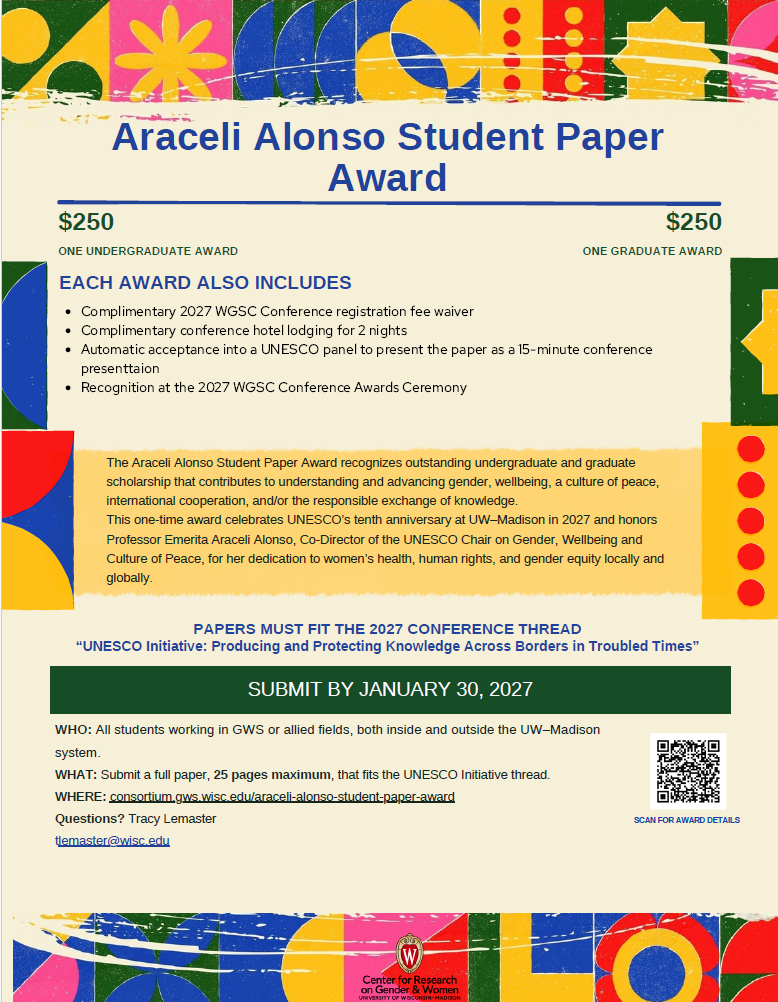
Award Offerings
One $250 Undergraduate Student Award &
One $250 Graduate Student Award Includes
Also includes:
- Complimentary registration for the 2027 WGSC Conference
- Two nights of complimentary conference lodging
- Automatic acceptance to a UNESCO panel to present a condensed, 15-minute version of your paper
- Recognition during the conference awards ceremony
Award Submission
Open to all students working in GWS or in allied fields, both inside or outside the UW–Madison system. Submit a full paper (25 pgs max) that fits within the thematic of the 2027 WGSC Conference thread, “UNESCO Initiative: Producing and Protecting Knowledge Across Borders in Troubled Times.” Winners are asked to present the paper at the 2027 WGSC Spring Conference. The paper can be either individually authored or co-authored. The awardee will be chosen by the conference’s submissions review panel based on how best their complete paper matches the award description. Submission deadline is January 30, 2027.
Scholarly Topics and Area Suggestions
Scholarship that contributes to understanding and advancing gender, wellbeing, a culture of peace, international cooperation, and the responsible exchange of knowledge are invited. Eligible papers for the award must fit within “UNESCO Initiative: Producing and Protecting Knowledge Across Borders in Troubled Times.”
Eligible papers could address one or more of the following areas:
1. Gender, a Culture of Peace, Poverty Reduction, Sustainable Development, and Human Rights: Research that contributes to gender equality, building lasting peace, advancing wellbeing and sustainable development, strengthening human rights, or promoting international collaboration.
2. Education: Work focused on equitable access to quality education, literacy, lifelong learning, educational innovation, or the protection and continuity of education during crises.
3. Natural Sciences: Research addressing scientific cooperation, environmental sustainability, climate and water-resource management, biodiversity conservation, or the responsible application of science for societal benefit.
4. Social and Human Sciences: Scholarship addressing racism, discrimination, inequality, social challenges, intercultural understanding, ethics, human rights, or emerging ethical frameworks, including the governance and societal implications of artificial intelligence and other technologies.
5. Culture and Heritage: Research concerned with safeguarding cultural and natural heritage, protecting historic and culturally significant sites, preserving cultural traditions, and promoting cultural diversity and intercultural dialogue.
6. Communication and Information: Work examining freedom of expression, freedom of the press, media and information literacy, access to reliable information, misinformation and disinformation, digital inclusion, or the role of communication in democratic and peaceful societies.
7. International Norms, Agreements, and Ethical Standards: Scholarship examining the development, implementation, effectiveness, or implications of international agreements, conventions, ethical principles, standards, and other forms of international cooperation.
8. Knowledge, Innovation, and Public Policy: Research that develops or evaluates new ideas, shares knowledge across disciplines or societies, translates research into practice, or contributes to evidence-based public policy.
9. Governance and Institutional Capacity: Work examining how governments, educational institutions, international organizations, civil society, and other institutions can strengthen their capacity to advance education, science, culture, communication, human rights, and sustainable development.
10. Crisis Response and Resilience: Research addressing the protection or restoration of education, cultural heritage, scientific resources, freedom of information, or communication systems during armed conflict, humanitarian emergencies, environmental disasters, or other crises.
Award Evaluation Criteria
Expectations by Academic Level:
1. Undergraduate papers should demonstrate strong intellectual engagement, effective use of evidence, familiarity with relevant scholarship, analytical ability, and a clear understanding of the significance of the topic. Originality may be demonstrated through a distinctive argument, case study, comparative perspective, application of existing knowledge, or synthesis of research.
2. Graduate papers should demonstrate a higher level of theoretical, methodological, or analytical sophistication. Graduate submissions should engage substantially with relevant scholarship and should make a discernible original contribution to knowledge, policy, methodology, theory, or professional practice.
Papers will be evaluated on the following criteria:
1. Relevance to the Award’s Mission and Thematic Areas: The paper demonstrates a clear and substantive connection to one or more of the award’s priority areas. Strong submissions explain how the topic relates to broader goals such as peace, human rights, sustainable development, international cooperation, education, science, culture, communication, or institutional resilience.
2. Originality and Significance: The paper presents an original research question, argument, interpretation, methodology, application, or perspective. It clearly demonstrates the significance of the issue and its potential contribution to scholarship, policy, professional practice, or society.
3. Quality of Research and Evidence: The paper demonstrates sound scholarship through appropriate use of relevant literature, data, primary sources, case studies, or other evidence. Where empirical research is undertaken, the methodology is appropriate to the research question and sufficiently explained.
4. Analysis, Critical Thinking, and Interdisciplinary Understanding: The paper goes beyond description to provide thoughtful, well-supported analysis. It recognizes complexity, considers relevant competing perspectives, and, when appropriate, makes meaningful connections across disciplines, cultures, communities, or national boundaries.
5. Contribution to International Cooperation, Policy, or Practice: The paper demonstrates the potential to inform action. This may include strengthening international collaboration, influencing public policy, developing ethical standards, improving institutional capacity, advancing education or scientific cooperation, protecting cultural heritage, strengthening access to reliable information, or improving responses to conflict and disaster.
6. Organization, Clarity, and Quality of Writing: The paper is well organized, clearly written, logically developed, and professionally presented. The central research question, thesis, or purpose is evident, and conclusions follow logically from the evidence and analysis.
Award Namesake
In recognition of her extraordinary dedication to advancing women’s health, human rights, and gender equity locally and globally, this award honors Professor Emerita Araceli Alonso for a career defined by transformative teaching, scholarship, advocacy, and service. As Co-Director of the UNESCO Chair on Gender, Wellbeing and Culture of Peace at UW–Madison, a faculty member in the School of Medicine and Public Health, and Distinguished Senior Lecturer in Gender and Women’s Studies, Professor Alonso has inspired generations of students while translating knowledge into action. Her United Nations award-winning Health by Motorbike initiative and its expanded Health by All Means model have advanced culturally responsive health promotion for women and girls in isolated communities worldwide, while her leadership in STREETS and two decades of work addressing human trafficking and sexual exploitation have strengthened the health, dignity, and rights of women and girls across continents. Through her pioneering programs, influential books, and enduring commitment to education and feminist leadership, Professor Alonso leaves a profound legacy of scholarship in service of a more just, healthy, and peaceful world.
Award Sponsor
The UNESCO Co-Chair on Gender, Wellbeing and a Culture of Peace is located at the University of Wisconsin–Madison in the Department of Gender and Women’s Studies, and was co-funded by the University and the Foundation for a Culture of Peace/Women’s Knowledge International (FCP/WKI), at Autonomous University of Madrid (UAM), Spain. Recognizing the 10th anniversary of the UNESCO Co-Chair at UW–Madison, the WGSC 2027 Spring Conference offers co-sponsorship with UNESCO-thematized thread, award series, and keynote. Learn more about UNESCO at UW–Madison.