2026 WGSC Conference

2026 WGSC Spring Conference
Join us as we honor the 50-year anniversary of the WGSC Conference!
Co-Convened by
UW System Women’s & Gender Studies Consortium &
UW System Office of the Gender and Women’s Studies Librarian
April 9-10, 2026
Memorial Union, 800 Langdon Street,
University of Wisconsin–Madison
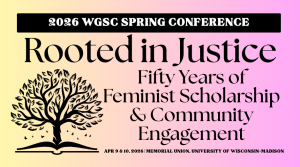

Rooted In Justice: 50 Years of Feminist Scholarship and Community Engagement
In commemoration of 50 years of statewide gender and women’s studies conferences, this year’s theme celebrates the deep roots of feminist scholarship in the academy while highlighting how scholars, students, and activists are developing new models of teaching, research, technological innovation, and community engagement to navigate ongoing political, institutional, and cultural pressures. At every turn, the challenges facing higher education threaten to unsettle the field’s hard-won successes. Gender and women’s studies is grounded in activism, intellectual courage, critical reflexivity, and a commitment to transforming higher education. From its earliest days, the field—fought for by students, community organizers, and visionary faculty—has carved out space to challenge power, center marginalized voices, and reimagine the boundaries of feminist knowledge production. This work has always occurred in tandem with other disciplines, community partners, and collaborators in varying institutional spaces.
Yet, the field has also had to reckon with its own exclusions—racial, gendered, ableist, ageist, and beyond. While there have been moments of transformative inclusion and coalition-building, these efforts have not always been complete or sustained. U.S. feminism has also been shaped by settler-colonialist legacies and imperial frameworks, often operating in tension with international feminisms and understandings of gender. The work of dismantling entrenched hierarchies within gender and women’s studies itself remains ongoing, demanding continued vigilance, humility, and accountability from practitioners and institutions alike.
Today, gender and women’s studies continues to demonstrate resilience, adapting to new conditions while remaining rooted in its founding principles of intersectionality, equity, and collective liberation. This year’s theme honors the legacies of the field’s founders while celebrating the creativity, persistence, and innovation that keep gender and women’s studies vibrant and vital. We invite participants—including those engaged in adjacent work within community spaces, allied academic disciplines, and related fields—to reflect on both the past and the future of the field, considering its historical impact, current struggles, and emerging possibilities.